vi
vi
 en
en
 ja
ja



In today’s fast-evolving business landscape, integrating AI into the workplace has become essential for optimizing operations and driving growth. AI is increasingly becoming an indispensable part of many organizations, helping unlock data-driven insights, improve productivity and efficiency, and enhance communication and collaboration.
To achieve sustainable growth in an increasingly dynamic world, understanding the critical role of AI in business operations is more important than ever.
Let’s explore how AI Workspace orchestrates intelligent AI Agents that can work independently and collaboratively to handle business and customer demands.
The AI Workspace Model
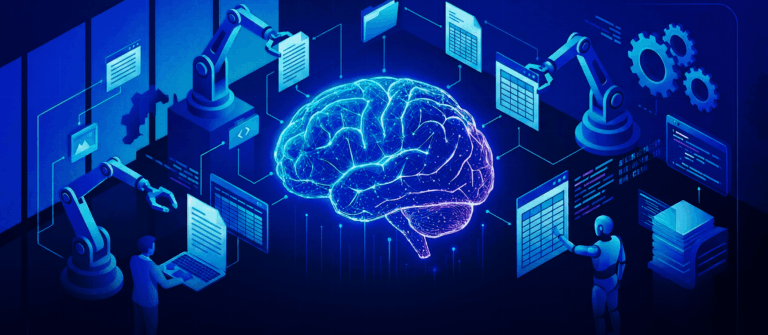
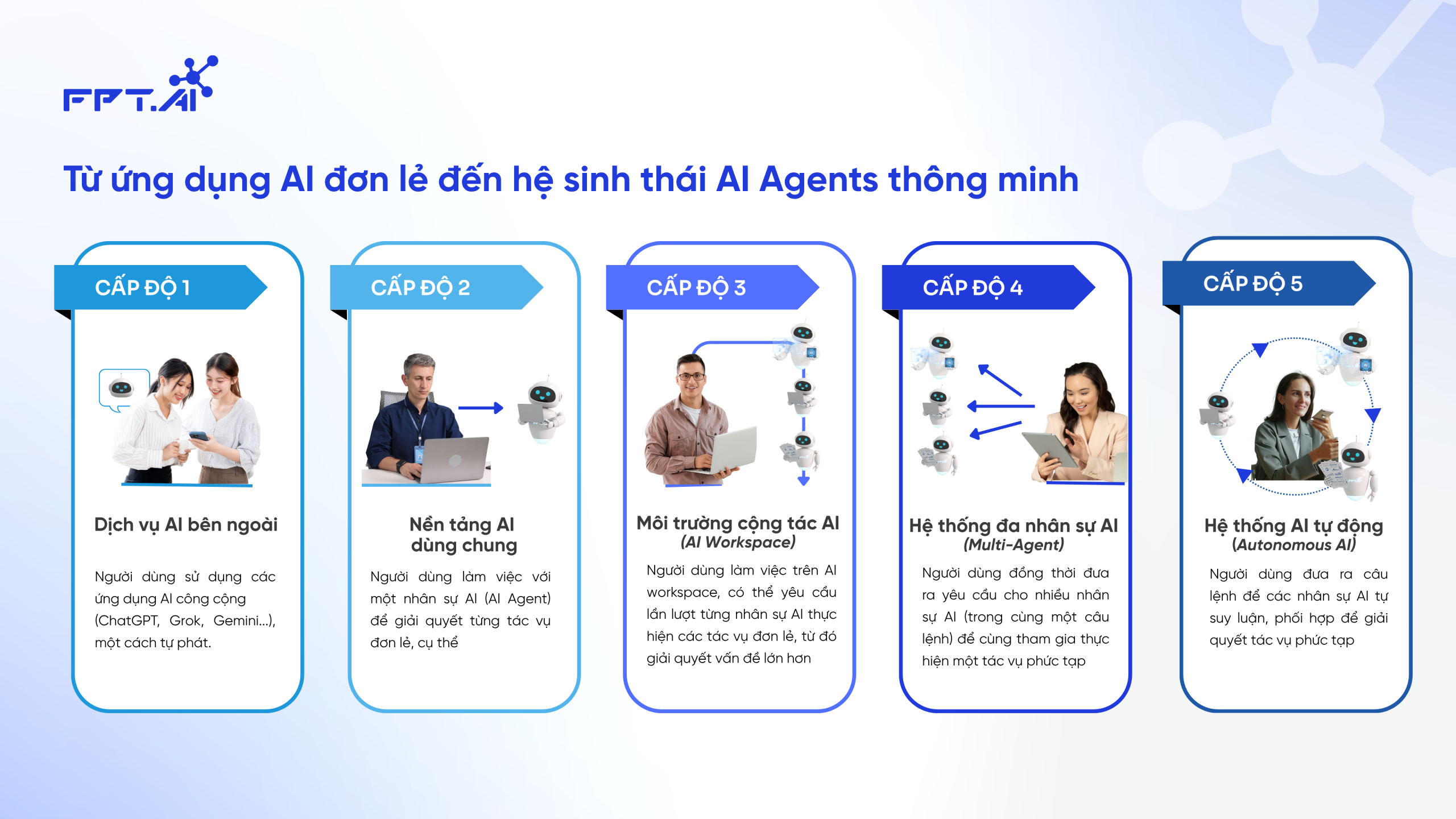
AI Workspace is developed as a solution to managing multi-AI Agent systems for enterprises. More than just a tool or a standalone platform, it is a “digital workspace” where AI is organized into a complete ecosystem. Within this environment, multiple AI Agents operate and collaborate like a real workforce—capable of executing tasks, supporting decision-making, and directly participating in business operations.
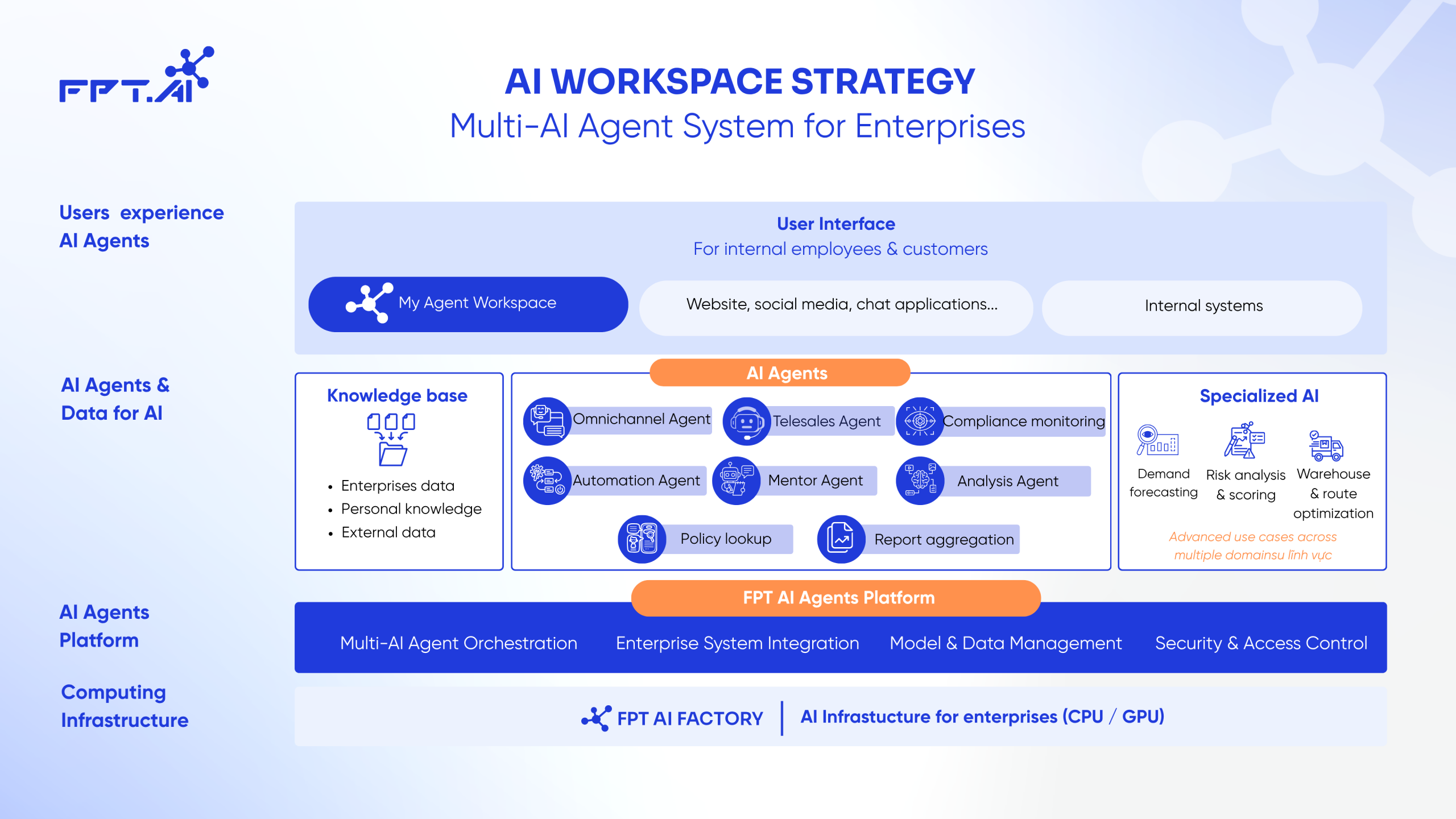
The user experience in AI Workspace is designed so that AI is present at every touchpoint. Users can interact with AI Agents through a dedicated workspace, websites, social media, messaging applications, or directly within internal systems. This allows AI to transcend a single interface and become a seamless capability layer across the entire working and customer interaction journey.
At the core of AI Workspace is a multi-agent system, where each AI Agent is assigned a clear role and responsibility—from omnichannel assistants, telesales, compliance monitoring, process automation, and internal training to demand analysis and report generation. The key value lies not only in the capability of each individual agent, but also in their ability to coordinate with one another, forming an increasingly intelligent and cohesive operational system over time.
The foundation of this entire system is data and knowledge. AI Workspace enables the integration and utilization of enterprise data, internal documents, and external data sources simultaneously. When data is standardized and centralized, AI goes beyond simple responses—it gains contextual understanding, allowing it to provide more accurate and relevant support aligned with real business operations.
Beyond general support tasks, AI Workspace also enables the deployment of specialized AI solutions tailored to specific business challenges. Applications such as demand forecasting, risk analysis and scoring, and supply chain optimization bring AI closer to participating in decision-making processes. This marks a significant shift—from helping businesses “do things faster” to helping them “do things right.”
To ensure the ecosystem operates effectively, a central orchestration platform is indispensable. This platform manages and coordinates multiple AI Agents simultaneously, integrates with existing enterprise systems, and controls models, data, and security elements. As a result, businesses can scale AI strategically rather than through fragmented and hard-to-manage deployments.
Underlying everything is a dedicated computing infrastructure. Powered by FPT AI Factory, this infrastructure ensures the capability to process large volumes of data at high speed with the stability required for enterprise environments. This is what enables AI to move beyond small-scale experiments and into large-scale, mission-critical implementations.
Use Case: Customer Service and Employee Training Powered by AI Agents
Scenario:
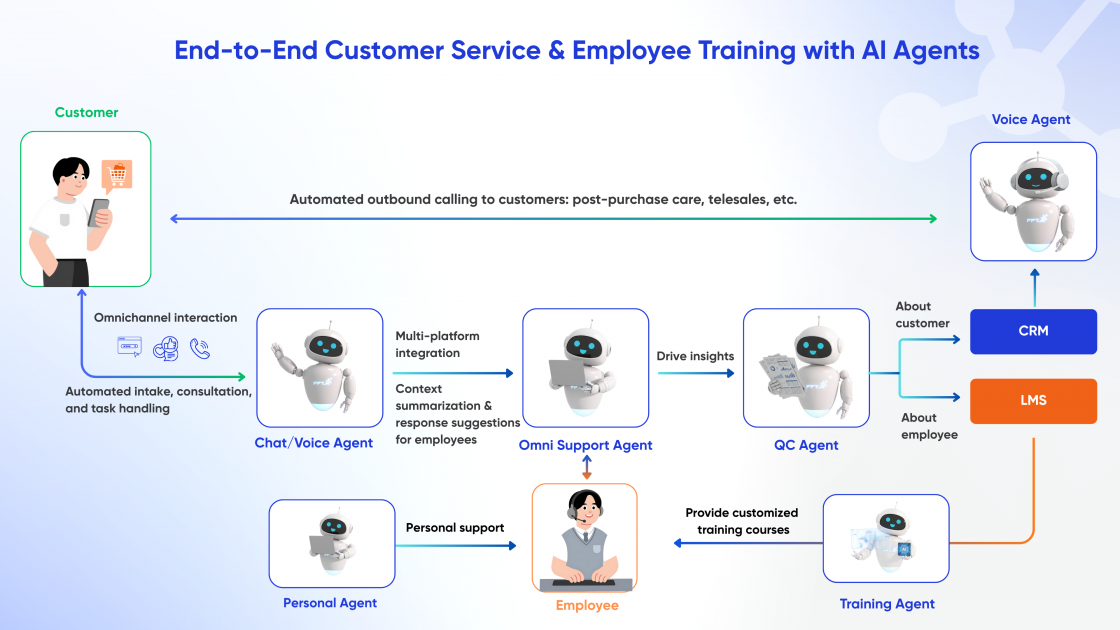
Customer A visits the website of TechMart (hypothetical) with the intent to purchase a tech product. From the very beginning of the journey, the customer interacts with an AI Chat Agent on the website. This agent goes beyond answering basic questions—it proactively gathers additional information to understand the customer’s needs, budget, and usage purposes. Once sufficient context is collected, the AI Chat Agent transfers the entire conversation to a customer service (CS) representative for further handling.
At this stage, the CS representative is not working alone but is supported by internal AI Agents. Based on the prior conversation data, these AI systems suggest appropriate responses, recommend consultation scripts, and assist in order creation more quickly and accurately. As a result, the consultation process becomes smoother, more personalized, and significantly faster.
After the order is created, an AI Enhance Agent reviews the entire interaction between the customer and the CS representative. The system then extracts two layers of insights: customer insights (behavior, needs, level of interest) and performance insights (how effectively the CS representative handled the interaction). These insights are then routed to two key internal systems: CRM and the training system.
On the CRM side, customer insights are used to activate AI Voice Agents. These agents automatically make follow-up calls to Customer A to assess post-purchase satisfaction, while also tactfully executing upsell or cross-sell activities based on previously analyzed needs.
Meanwhile, internally, the LMS system receives performance insights about the CS representative. This data is passed on to AI Mentors—“digital coaches” capable of personalizing training content. Based on each employee’s strengths and areas for improvement, AI Mentors recommend tailored learning programs, helping continuously enhance skills and service quality over time.
This entire journey demonstrates how five AI Agents work seamlessly together—not only to deliver better customer experiences but also to continuously optimize operations and develop internal capabilities.
Conclusion
AI Workspace represents a major shift in how enterprises approach AI. From isolated applications, AI evolves into a unified ecosystem; from a supporting role, it becomes an integral part of operations; and from initial experimentation, it grows into a core capability. In the long-term AI race, organizations that build a well-structured AI Workspace will gain a clear advantage in speed, efficiency, and adaptability for the future.