vi
vi
 en
en
 ja
ja



Rapid urbanization is creating growing challenges for cities around the world, including traffic congestion, overstretched infrastructure, environmental pollution, inefficient resource management, and the need to improve residents’ quality of life. In this context, AI is emerging as a core technology that can help governments and businesses reshape how cities are built, managed, and developed.
Beyond automating tasks, AI can analyze vast amounts of data from IoT sensors, cameras, satellites, transportation systems, and digital platforms to generate forecasts, optimize operations, and support real-time decision-making. This provides an important foundation to build smart cities.
Reducing Traffic Congestion and Improving Mobility
Transportation is one of the most persistent challenges of major cities. AI can analyze data from cameras, traffic sensors, GPS systems, and public transportation to manage traffic flows in real time.
Key applications include:
- Predicting traffic congestion before it occurs.
- Optimizing bus routes and public transportation.
- Supporting smart navigation and recommending less congested routes for citizens.
As a result, travel times can be reduced, fuel consumption lowered, and emissions cut.
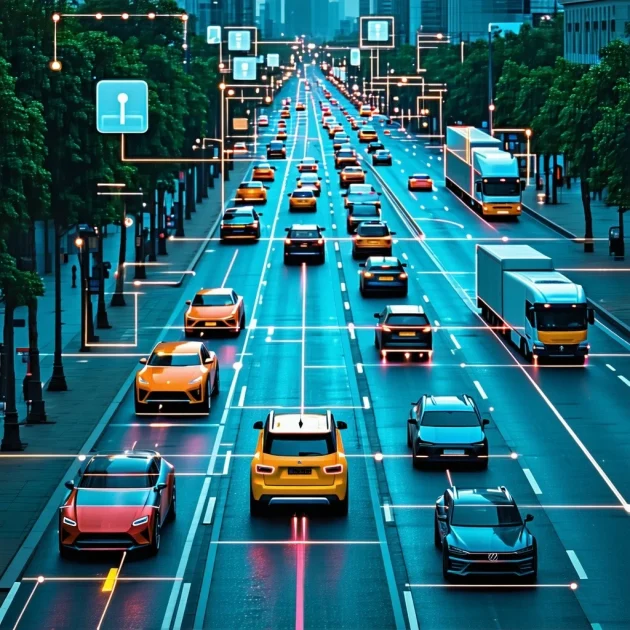
Image 1. AI-powered vehicle recognition
Infrastructure Management and Predictive Maintenance
Infrastructure such as roads and bridges, water supply and drainage systems, and power grids requires continuous monitoring to prevent serious failures. Combined with IoT, AI can help shift from scheduled maintenance to predictive maintenance by:
- Detecting signs of deterioration through images or sensor data.
- Predicting when equipment is at risk of failure.
- Automatically prioritizing maintenance schedules based on risk levels.
- Providing early warnings to management agencies to minimize service disruptions.
This can reduce operating costs while extending the lifespan of urban infrastructure.
Improving Energy and Resource Management Efficiency
AI plays an important role in building greener cities by optimizing resource use and improving infrastructure efficiency. Through real-time data analysis, AI can automatically adjust public lighting systems based on pedestrian and traffic flows, forecast electricity demand to balance loads and reduce energy waste, optimize water supply network operations, and detect leaks at an early stage. In addition, AI can continuously monitor emissions and air quality, enabling authorities to make timely decisions to protect the environment and promote sustainable urban development.
Supporting Security Management and Emergency Response
AI supports urban security monitoring by enabling authorities to analyze video and data in real time. These systems can help authorities:
- Detect unusual behavior in public areas.
- Identify traffic accidents or fires as they occur.
- Automatically send alerts to relevant authorities.
- Support the coordination of emergency response teams and vehicles.
Shortening response times can help reduce casualities and property damage.
Supporting Environmental Management and Sustainable Urban Development
AI can analyze data from monitoring stations, IoT sensors, and satellite imagery to monitor and assess urban environmental conditions in real time. This enables systems to forecast air quality, monitor noise pollution in residential areas, detect potential flooding at an early stage based on weather and rainfall data, and optimize waste collection, sorting, and treatment.
Applying AI to environmental management not only helps authorities respond more quickly to potential risks but also contributes to creating greener, safer, and more sustainable living environments for urban residents.
Challenges of Implementing AI in Urban Development
Applying AI to urban development and management offers significant potential but also presents a number of challenges. Many local authorities continue to face difficulties because data remains fragmented across agencies and has not been standardized, while investment in digital infrastructure, sensor systems, and data-processing platforms can be substantial. In addition, information security, citizen privacy, and the shortage of professionals with expertise in AI and data science create pressing challenges.
To ensure that AI is implemented effectively, transparently, and responsibly, cities need appropriate legal and governance frameworks, alongside long-term digital transformation strategies supported by close collaboration between government authorities, technology companies, and research organizations.
Looking ahead, as data becomes increasingly integrated and AI models continue to mature, cities that effectively leverage the power of AI will be better positioned to strengthen governance capabilities, attract investment, and achieve sustainable development.