vi
 en
 ja



Nemotron-Personas-Vietnam dataset is fueling the next generation of FPT’s telesales voicebots, which will better adapt tone and content and be more accurate from the very first customer call. The synthetic dataset, based on real-world demographic, geographic, and personality trait distributions of people in Vietnam, enables the voicebot to model realistic Vietnamese customers and customize call strategies for individuals to improve telesales conversion rates.
One-Size-Fits-All Scripts are Not Effective
Most telesales voicebots today follow one script for customers. The same opening, the same pitch, the same pace, regardless of who picks up the phone. The result is predictable: low conversion, early hang-ups, and a poor experience for customers who feel talked at rather than understood.
A retiree in Hanoi and a young engineer in Ho Chi Minh City do not respond to the same language, the same offers, or the same pace. A fixed script ignores that. A personalized voicebot can adjust.
The challenge is doing this without real customer data, which is sensitive, regulated, and often unavailable for training. In banking and insurance, accessing real customer data for AI development can take months of approval, and even then the data is partially redacted and difficult to train on effectively.
Building Customer Personas That Adapt
Based on the user persona, the voicebot adapts how it speaks, such as tone, pace, and content, from the very first call, then gets more accurate with each interaction.
Nemotron-Personas-Vietnam dataset provides the foundation: 1,000,000 fully synthetic personas, grounded in Vietnam’s official statistics from the General Statistics Office (GSO), including the Population and Housing Census 2024 and the Vietnam Household Living Standards Survey (VHLSS) 2024, as well as from FPT Smart Cloud and Quantum AI & Cyber Security Institute (FPT Corporation). The dataset covers rich narrative fields, including career goals, skills, hobbies, and cultural background. Because the personas are synthetic rather than drawn from real individuals, they reduce privacy risk and let them train and evaluate the voicebot without touching real customer data.
For the dataset’s full methodology, schema, and coverage, see our technical blog.
How The Dataset is Used
The pipeline runs as a continuous loop: initialize persona → strategy → call → update persona → next call is better.
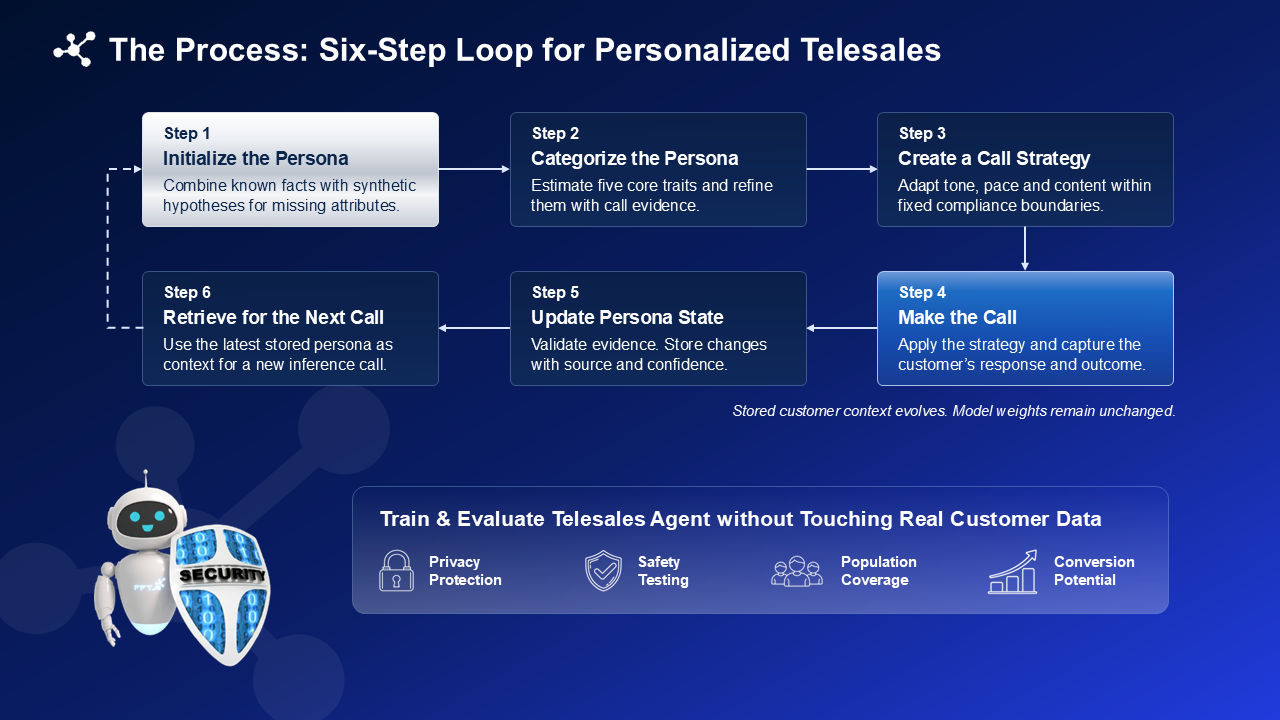
Step 1. Initialize the customer persona
When a new customer enters the pipeline, the system builds an initial persona by combining known customer information with plausible synthetic assumptions for missing attributes.
Known customer attributes: available demographics and customer information such as age, region, occupation, income, education, CRM records, transaction history, call data, and observed behavior form the factual foundation of the persona.
Nemotron-Personas-Vietnam: used to fill gaps in the initial profile by retrieving or sampling personas that are compatible with the customer’s known attributes. Missing characteristics, such as lifestyle context, preferences, personality, or behavioral tendencies, are treated as synthetic hypotheses rather than inferred facts about the customer.
Progressive enrichment: as more customer-specific evidence becomes available through conversations, CRM, transactions, call data, or behavioral signals, synthetic assumptions are updated, replaced, or removed.
This produces a working customer persona that is complete enough to support simulation and personalization from the beginning, while explicitly distinguishing between observed facts, population-level priors, and synthetic assumptions.
Step 2. Categorize customer personas
All of this converges into a customer persona defined by five core traits, refined over time based on call history:
| Trait | What it captures |
| patience | How long the customer stays engaged before losing interest |
| financial_familiarity | How comfortable they are with financial terms and concepts |
| capital_need | Whether they have an active need for capital or savings products |
| price_sensitivity | How strongly they react to price and fees |
| trust_sensitivity | How much they need reassurance and credibility signals |
These traits are not static. They start as an estimate from the initial persona and are updated after every call.
Step 3. Create a call strategy based on personas
Based on the persona, the voicebot builds a communication strategy:
- Match scripts to the current persona: select the opening, pitch, and closing that fit this customer
- Write persona-based descriptions: generate a conversational context that includes persona, description, conversation_flow, and scenario
- Create fixed barriers: compliance rules and core conversation branches that the voicebot cannot cross, regardless of persona. These keep every call within regulatory and brand boundaries.
The goal is not stereotyping. It is starting from a grounded, statistically realistic profile instead of a blank slate, then refining from there.
| Persona trait | Voicebot adaptation |
| High patience, low financial_familiarity | Slower pace, plain-language explanations, focus on security and stability |
| Low patience, high financial_familiarity | Brisk pace, direct tone, highlight efficiency and premium features |
| High price_sensitivity, rural region | Local references, practical framing, seasonal and cash-flow language |
| High trust_sensitivity, household of 4 | Family-oriented framing, credibility signals, education and savings products |
Step 4. Make the call
The voicebot makes the call using the selected strategy and records how the customer responds: engagement level, objections, questions, tone of voice, and whether the call ended in conversion, follow-up, or hang-up.
Step 5. Update the Persona State
After each call, the system updates the stored customer persona:
- The call recording and transcript are captured.
- E5 encoding and conversation analysis extract signals such as objections, engagement, sentiment, preferences, and outcomes.
- An evidence check determines whether each signal is strong enough to modify the persona.
- Validated attributes are written back to the persona database, with their source and confidence; otherwise, the existing state is retained.
Over time, observed customer behavior progressively refines or replaces the synthetic assumptions used to initialize the persona.
No model weights are updated — the learning happens in the stored customer state.
Step 6. Retrieve the Updated Persona for the Next Call
On the next interaction, the system retrieves the latest persona state from the database and provides it as context for a new inference call.
The model itself remains unchanged. What improves is the customer-specific context: as more direct evidence becomes available, the agent relies less on initial synthetic assumptions and more on the customer’s observed preferences and behavior.
Retrieve updated persona → inject as context → inference with unchanged model weights.
How Nemotron-Personas-Vietnam Dataset Makes This Work
The key advantage is that the voicebot can be trained and evaluated on realistic customer profiles without needing real customer data. In banking and insurance, real customer data is sensitive, regulated, and slow to access. Nemotron-Personas-Vietnam provides a privacy-preserving, synthetic foundation that keeps real customer data out of training and evaluation: 1,000,000 personas grounded in Vietnam’s own statistics, covering the full range of income brackets, regions, occupations, and education levels the voicebot will encounter.
This allows teams to develop and evaluate the voicebot using synthetic profiles, reducing reliance on real customer records. Testing should still assess privacy risks, demographic bias, and appropriate use, particularly when the system is connected to live customer data.
Ultimately, the voicebot is designed to lift telesales conversion by matching how it speaks to each customer. Personalization from the first call reduces early hang-ups. Persona updates from each interaction make subsequent calls more relevant. Over time, the voicebot converges on a more accurate model of each customer, which is where conversion gains should come from.
——
Get started for free on HuggingFace: https://huggingface.co/datasets/nvidia/Nemotron-Personas-Vietnam
You can load the dataset with the following lines of code.
from datasets import load_dataset
# Personas tiếng Việt — Vietnamese personas
nemotron_personas = load_dataset(“nvidia/Nemotron-Personas-Vietnam”, split=”train”)